
Silverwater NSW 2128
Carpet Cleaning Silverwater
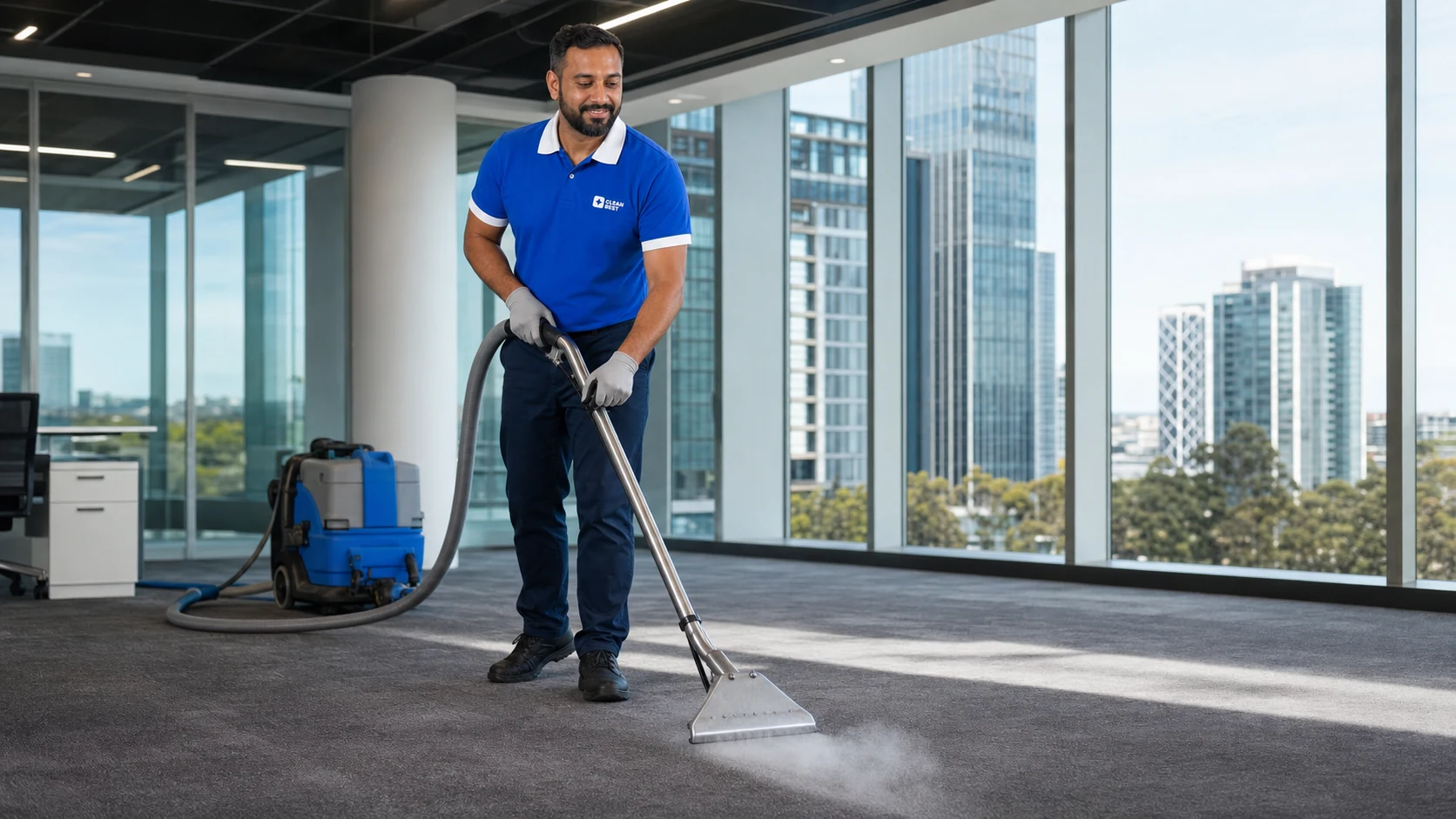
Hot-water extraction for the one carpeted part of the building — the front office and the meeting room, and the grey lane running across it from the door the warehouse staff use. Scheduled after hours, dry by morning.
- Hot-water extraction, not a bonnet buff
- Traffic lanes and the warehouse threshold worked first
- After-hours scheduling so it dries overnight
- Quoted as its own line, never buried in a monthly figure
What sits behind the number
Every line here is a document, not an adjective. Ask for any of them and it is in your inbox the same day.
- $20m public liabilityCertificate of currency on request
- SWMS before the first shiftWith the safety data sheet for every chemical
- No lock-in contractQuote in writing within 24 hours
What is carpet cleaning in Silverwater?
Carpet cleaning in Silverwater is the deep cleaning of carpet in business premises in the suburb of Silverwater, postcode 2128, in the City of Parramatta local government area in Sydney. Because Silverwater is a light industrial estate, the carpet in a typical tenancy is confined to the front office, the meeting room and sometimes a mezzanine — a small area next to a concrete slab and a roller door.
Clean Best cleans that carpet by hot-water extraction: pre-treating the fibre, agitating the pile, injecting hot solution under pressure and recovering it immediately with the suspended soil. The dominant problem in Silverwater is a grit traffic lane running from the warehouse threshold to the desks, caused by abrasive particles walked in from the slab and hardstand and ground into the pile. Vacuuming removes loose grit but cannot lift soil that is already embedded; extraction can.
Clean Best schedules extraction outside working hours so the carpet dries overnight, and quotes it as a separate periodic line item rather than folding it into a monthly cleaning price. Every Silverwater job is quoted after a free walkthrough, with one fixed figure confirmed in writing within 24 hours.
- Rostered from Seven HillsCrews rostered to Silverwater from the Seven Hills depot
- Police-checked, inducted cleanersInducted on your access procedure before shift one
- $20m public liabilityCertificate of currency for your WHS file
- Quote in writing within 24 hoursFixed price, no lock-in contract
One carpeted room, one hard job
The carpet in an industrial unit lives a harder life than office carpet
Carpet cleaning Silverwater tenants need is usually about one room. In this suburb the building is a shed, the floor is concrete, and the only carpet in the place is in the front office and the meeting room — maybe a mezzanine. It is a small area, which makes people assume it is a small job. It is not, because that carpet is sitting a few metres from a slab with forklifts on it and a roller door open to the hardstand, and everything that happens out there ends up in the pile in here.
The mechanism is grit. Fine abrasive particles — concrete dust, road grit, the residue of whatever crosses the yard — get onto boots and get walked through the connecting door. Foot traffic then does the rest, grinding those particles down into the base of the fibre along the exact route people walk. That route becomes the grey lane you can see from the doorway. It is not a spill and it is not a shadow. It is soil that has become part of the carpet, and while it is in there it is also cutting the fibre every time somebody stands on it, which is why an old lane looks flat and dull as well as dark. Left long enough, that is permanent: the pile is abraded, not dirty, and no cleaning process brings back fibre that has been cut.
Why vacuuming is prevention, not treatment
We vacuum office carpet every visit and it genuinely matters — it removes loose grit before foot traffic has a chance to work it into the pile. That is the whole value of it, and it is the cheapest carpet protection there is. What vacuuming cannot do is lift soil that is already embedded. Once the grit is at the base of the fibre, suction across the surface does not reach it. People vacuum harder, more often, with a better machine, and the lane stays exactly where it is, and they conclude the carpet is beyond saving. Usually it is not. It just needs a different process.
What hot-water extraction actually does
Extraction is a four-part process and skipping any of them is why some carpet cleans do not last. First the carpet is pre-treated, so the soil has time to release its grip on the fibre. Then the pile is agitated, so the solution reaches the base rather than sitting on the tips. Then hot solution is injected under pressure, and — this is the part that matters — it is recovered immediately, in the same pass, with the suspended soil in it. What you are left with is carpet that is damp rather than wet, and soil that has left the building in a tank.
A bonnet or dry buff, by contrast, cleans the top of the pile and leaves the base alone. It looks impressive for a fortnight, then the soil at the base wicks back to the surface and the lane reappears, and everybody decides carpet cleaning does not work. On an industrial office carpet with a grit lane, extraction is the process. There is not really an argument.
How often, and who decides
The honest answer is that we do not know until we have seen your carpet come back. An office three doors from a live roller door with a yard full of traffic will load its lane far faster than a closed office suite in the same street. So we set an interval at the walkthrough based on the state of the lane, run the first extraction, and then watch how quickly it returns. If it comes back in half the time we predicted, we tell you and we shorten the interval. If it does not, we lengthen it and you pay us less. That is not a generous gesture; it is the only method that produces a number worth anything.
Matting: the cheapest carpet cleaning there is
Nearly every Silverwater unit we walk into could halve its carpet problem with matting at the connecting doorway, and most of them either have none or have a mat so old it is now a grit reservoir. A proper entry system at the threshold between the shed and the office catches the abrasive before it gets to the pile. We will point at that doorway on the walkthrough. It is not a service we are selling you — it is the cheapest advice on this page and it reduces what you spend with us.
Scheduling, drying and cost
Extraction is scheduled outside working hours — an evening or a weekend — so the carpet has the night to dry with airflow and nobody is walking across damp pile in steel-capped boots. The area needs to be cleared of chairs and floor-standing items, which we agree at the booking rather than discovering on the night. Price follows the area, the fibre and backing, how bad the lane is, and whether furniture has to be moved. It is quoted as its own periodic line, separate from any ongoing cleaning figure, so you can see exactly what it costs and how often it is planned.
Call 02 5839 3012 and we will look at the lane and tell you honestly whether it will come back.
By area
Carpet extraction in a Silverwater office, area by area
The lane and the threshold carry nearly all the soil. Everything else is maintenance around them.
| Area | What we do, and with what | How often |
|---|---|---|
| Warehouse threshold and entry | Pre-treated, agitated and extracted twice — this is where the grit arrives | Every extraction, worked first |
| Traffic lanes | Pre-treatment with dwell time, mechanical agitation, then hot-water extraction | Every extraction |
| Open office carpet | Extracted at standard pressure after the lanes are done | Every extraction |
| Meeting room | Furniture moved by agreement, carpet extracted, edges and corners detailed | Every extraction |
| Under and around desks | Chair-castor wear zones treated separately; loose items cleared before the visit | Every extraction |
| Spot and spill treatment | Treated on the day it is reported; the longer a spill sits, the less comes out | As reported |
| Routine vacuuming | Removes loose grit before traffic grinds it in — prevention, not treatment | Every cleaning visit |
| Entry matting | Checked and cleaned; an old saturated mat is a grit reservoir, not a barrier | Every visit, replaced as needed |
What's included
What a Silverwater carpet extraction includes
What actually happens on the night, in the order it happens.
- Walkthrough of the lane before quoting, with an honest read on what will lift
- Area cleared of chairs and floor-standing items, agreed at booking
- Thorough dry vacuum first — extraction over loose grit just makes mud
- Pre-treatment applied with proper dwell time
- Pile agitated so solution reaches the base of the fibre, not just the tips
- Hot solution injected under pressure and recovered in the same pass
- Warehouse threshold and traffic lanes worked first and hardest
- Spots and spills treated individually rather than run over
- Airflow set up so the carpet is dry by the morning, not damp at nine
- Entry matting checked, and replaced if it has become a grit reservoir
- Interval reviewed after the first extraction, based on how fast the lane returns
- Extraction quoted as its own periodic line, never folded into a monthly figure
Where a traffic lane is abraded rather than soiled — the fibre cut flat by years of grit underfoot — no cleaning process restores it, and we will tell you that before you pay rather than after.
Pricing
What carpet cleaning costs in Silverwater depends on the lane, not the square metres
Priced on the area, the fibre and backing, how far the traffic lane has gone, and whether furniture has to be moved. It is quoted as its own periodic line item, separate from any ongoing cleaning figure, so you can see exactly what the extraction costs and how often it is planned. Fixed price, in writing, before the machine arrives.
Single Silverwater unit
One tenancy in a multi-unit complex: a modest slab, one roller door, a front office and the toilets behind it.
- Walk-behind scrubber on the slab, at the frequency the traffic actually needs
- Roller door threshold and the apron outside it swept every visit
- Front office, kitchenette and amenities on their own separate scope
- Racking dusting run as a scheduled periodic program, not squeezed in
Fixed price, in writing, before anyone sets foot on site.
Full shed
A standalone warehouse or factory with racking, more than one dock, a mezzanine office and a real amenities block.
- Ride-on scrubbing planned aisle by aisle around pick and dispatch
- High-level racking dusting from proper height access, on a written schedule
- Amenities serviced more often than the slab, because they need it
- Named supervisor, site register and a written monthly audit against scope
Fixed price, in writing, before anyone sets foot on site.
Multi-shift operation
Distribution and transport operations that never fully stop — the ones this estate is full of.
- Cleaning slotted between shifts or into agreed quiet windows
- Documented traffic management, coned working areas, no machine in a live aisle
- SWMS, safety data sheets and induction records lodged before we start
- Periodic slab sealing and line-marking programs quoted separately
Fixed price, in writing, before anyone sets foot on site.
Free walkthrough of the Silverwater unit while it is running, then a written quote within 24 hours.
How it works
Getting a Silverwater site onto a proper program, in four steps
- 1
Ring us and describe the unit
Call 02 5839 3012. What is the floor, what runs across it, how many docks, how high does the racking go, and how many people share the toilets.
- 2
We walk it while it is working
A supervisor comes to the Silverwater address during operation. A shed at rest tells you nothing about where the traffic actually goes.
- 3
Scope, safety pack and one figure
Within 24 hours: the price, the task list split into every-visit, weekly and periodic work, plus SWMS and safety data sheets for your WHS file.
- 4
The same operator starts
Inducted individually on your access and traffic procedure, working to the agreed windows, with a named supervisor auditing the site monthly.
FAQ
Carpet cleaning Silverwater — what office managers ask
Where the carpet is, what the grey lane is, why vacuuming will not fix it, how extraction works, frequency, scheduling and cost.
Where is the carpet in a Silverwater unit, exactly?
In most Silverwater tenancies there is one carpeted area and that is it: the front office and the meeting room, occasionally a mezzanine. Clean Best scopes carpet cleaning here around that reality rather than around a floor plan full of soft flooring. It is a small area doing a hard job, sitting a few metres from a concrete slab and a roller door, which is why it soils faster than an office carpet anywhere else.
What is the grey lane across our office carpet?
It is grit, and Clean Best sees it in nearly every Silverwater unit. Fine abrasive particles get walked in from the slab and the hardstand, and foot traffic grinds them into the pile along the route from the warehouse door to the desks. That lane is not a stain sitting on the surface — it is soil embedded in the fibre, and it also cuts the fibre, which is why the lane eventually looks flat as well as dark.
Will vacuuming fix it?
No, and Clean Best would rather say so than sell you more vacuuming. Regular vacuuming removes loose grit before it is worked in, which is genuinely preventive and it is why we vacuum every visit. Once the soil is embedded in the pile, only hot-water extraction lifts it — solution injected under pressure, agitated, then recovered with the soil in it. Vacuuming after that point maintains the result; it cannot produce it.
How does hot-water extraction actually work?
Clean Best pre-treats the carpet, agitates the pile so the solution reaches the base of the fibre, injects hot solution under pressure and immediately recovers it along with the suspended soil. The result is carpet that is damp rather than wet, and drying is a matter of hours with airflow rather than a day. Traffic lanes and the threshold from the warehouse are worked first and hardest, because that is where the soil actually is.
How often should an industrial office carpet be extracted?
Clean Best sets the interval from what the carpet is exposed to, not from a template. An office three doors from a live roller door with forklift traffic outside it will need extraction meaningfully more often than a closed office suite. We look at the traffic lane at the walkthrough, recommend an interval, and adjust it once we have seen how fast the lane comes back — which is the only honest way to set it.
Can you work around us or does the office have to be empty?
Clean Best schedules extraction outside working hours in a Silverwater unit, usually in the evening or over a weekend, so the carpet has the night to dry and nobody is stepping across damp pile in steel-caps. The office does need to be cleared of chairs and floor-standing items in the areas being done. We agree that at the booking rather than arriving to find a room we cannot work in.
Do you do the carpet at the end of a lease?
Yes. Clean Best extracts office carpet as part of a Silverwater make-good, and it is one of the areas an agent looks at first because it is the part of the unit that reads as a room. Extraction is scheduled after the fit-out and furniture are out and before the slab is scrubbed, so nothing is dragged back across freshly cleaned pile.
What does carpet cleaning cost in Silverwater?
Clean Best publishes no prices. Carpet extraction in a Silverwater unit is priced on the area, the fibre and backing, how bad the traffic lane is, and whether furniture has to be moved. A supervisor looks at it during the walkthrough and quotes it as a separate periodic line rather than folding it into a monthly cleaning figure, so you can see exactly what the extraction costs and how often it is planned.
Keep exploring
The rest of the office, and the shed behind it
Carpet is one line in a Silverwater scope. These are the others most tenants buy alongside it.
Get carpet cleaning Silverwater offices actually need
Hot-water extraction, lanes worked first, dry by the morning, quoted on its own line. Free walkthrough, fixed written price within 24 hours. Call 02 5839 3012.