
Silverwater NSW 2128
Warehouse Cleaning Silverwater
The page this suburb is actually about. Scrubbers on the slab, racking dusted from proper height access, docks and hardstand on the every-visit list, and the safety pack in your WHS file before the first operator walks through the roller door.
- Ride-on and walk-behind scrubbers, not mops
- Racking dusted from height, vacuum-extracted
- Cleaning fitted around live aisles and dispatch
- SWMS and safety data sheets before shift one
What sits behind the number
Every line here is a document, not an adjective. Ask for any of them and it is in your inbox the same day.
- $20m public liabilityCertificate of currency on request
- SWMS before the first shiftWith the safety data sheet for every chemical
- No lock-in contractQuote in writing within 24 hours
What is warehouse cleaning in Silverwater?
Warehouse cleaning in Silverwater is the scheduled cleaning of industrial premises in the suburb of Silverwater, postcode 2128, in the City of Parramatta local government area in Sydney. Silverwater is one of Sydney’s densest light industrial estates, so the work covers concrete slab, pallet racking and high-level structure, loading docks and thresholds, external hardstand, and the front or mezzanine office and amenities attached to the unit.
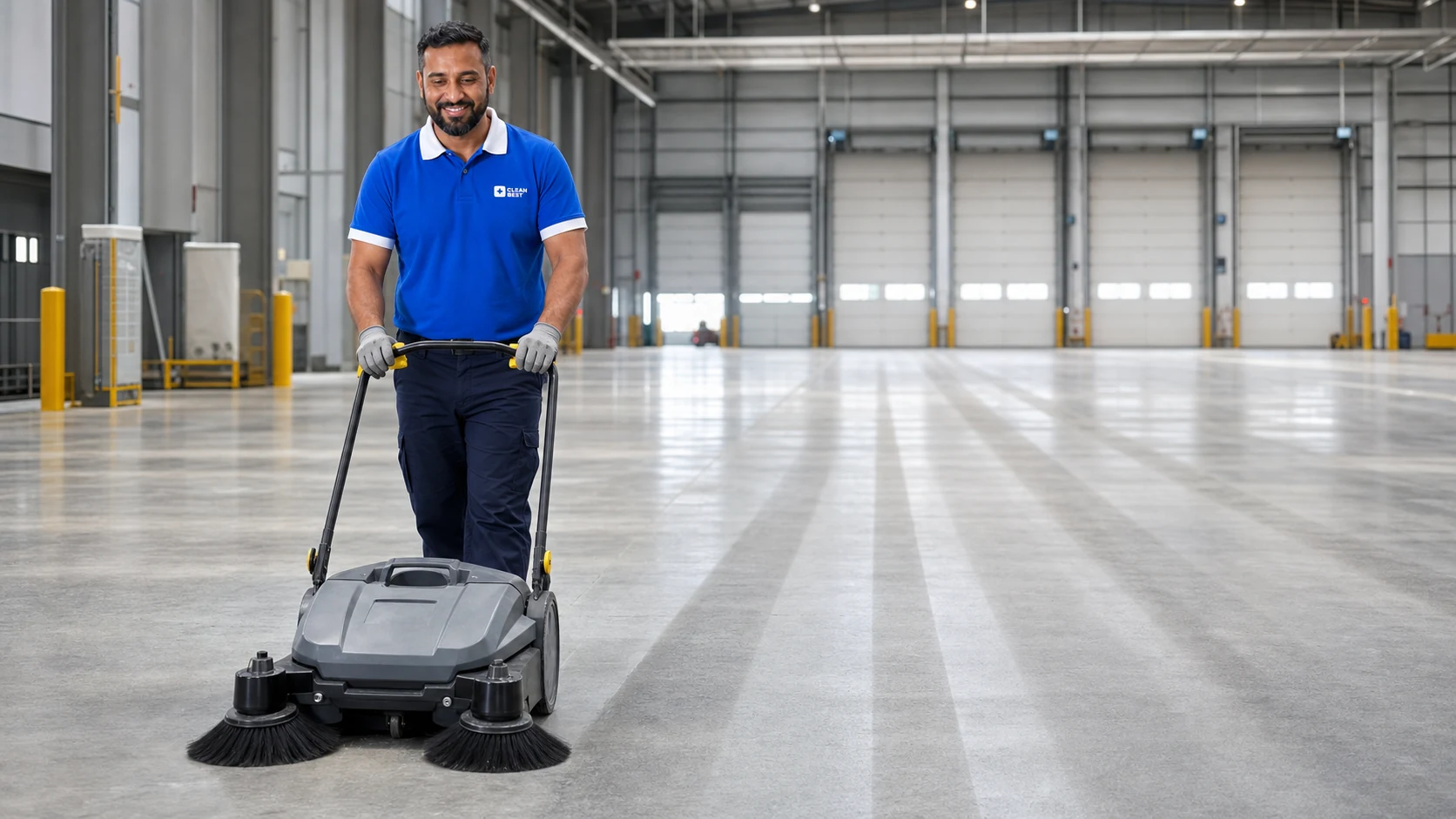
Clean Best cleans warehouse slab with ride-on or walk-behind scrubbers rather than mops, because a mop redeposits the tyre rubber, oil and dust that forklift traffic works into concrete. Clean Best dusts racking and high-level structure from proper height access with vacuum extraction, as scheduled periodic work rather than as part of a nightly visit.
Clean Best supplies safe work method statements and a safety data sheet for every chemical before the first shift, and carries $20m public liability cover. It quotes each Silverwater warehouse after a free walkthrough carried out while the site is operating, confirms one fixed figure in writing within 24 hours, and works on a rolling agreement with thirty days notice rather than a lock-in contract.
- Rostered from Seven HillsCrews rostered to Silverwater from the Seven Hills depot
- Police-checked, inducted cleanersInducted on your access procedure before shift one
- $20m public liabilityCertificate of currency for your WHS file
- Quote in writing within 24 hoursFixed price, no lock-in contract
The slab, the racking, the docks
Cleaning a working shed, not a floor plan
Warehouse cleaning Silverwater operators need is a different trade from office cleaning, and the gap shows up fastest on the floor. An industrial slab in 2128 is not dirty in the way a carpet is dirty. It carries tyre rubber pressed in by forklift wheels, oil and hydraulic weep from the machines that live on it, timber dust off pallets, shrink-wrap, strapping, and whatever your own product sheds when a carton splits. That is a contamination layer, not a dust layer, and it does not lift with water and agitation from a mop head.
What a mop actually does on that surface is move the contamination into a bucket and then put most of it back on the next pass. The floor looks wet, dries grey, and stays slick — which is the part that matters, because a slick slab in a building full of forklifts and people on foot is a WHS problem wearing a housekeeping costume. A scrubber breaks that cycle: it lays down solution, agitates the surface mechanically, and recovers the dirty water in the same pass. The contamination leaves the building in a tank. That is the whole argument, and it is a safety argument long before it is a presentation one.
Matching the machine and the chemistry to the floor
Not every Silverwater slab wants the same treatment. Bare sealed concrete, an epoxy coating, a polished finish and an old porous slab with thirty years of oil in it all respond differently, and a chemical that strips one will ruin another. Nor is the machine a single choice: a tight multi-unit tenancy with racking close to the walls is walk-behind territory, while a big open distribution floor is where a ride-on earns its keep. We look at the floor, the aisle widths, the turning circles and the door heights at the walkthrough, and we tell you which machine is going to come and why.
Racking, and the dust nobody looks at
Dust does not stay on beams. It settles on racking rails, on the tops of cartons, on cable trays, on light fittings and in the roof structure, and it accumulates quietly for as long as everyone agrees not to look up. Then something disturbs it and it falls — into an open carton, onto a picked order, into a customer’s receiving bay. At that moment it stops being a housekeeping issue and becomes a quality complaint, and in food, pharma and packaging operations it becomes an audit finding.
So we schedule racking and high-level dusting as periodic work with its own scope and its own price. It is done from proper height access, with vacuum extraction rather than blowing dust off a beam so it lands in the aisle underneath, which is the trick that makes the beam look clean and the floor worse. How often depends entirely on what your operation sheds. We set an interval at the walkthrough, then adjust it once we have seen what actually lands.
The docks and the strip everybody forgets
The threshold under the roller door is where the outside gets in. Grit, rainwater, oil drips, cigarette ends, shrink-wrap and pallet splinters gather in that strip, and every set of tyres that crosses it carries the lot straight onto your scrubbed slab. Cleaning the floor and ignoring the threshold is why a warehouse can look filthy again two hours after the crew has left, and why the client concludes the clean was not worth the money. Dock faces, thresholds, door tracks and the apron of hardstand outside them go on the every-visit list here, not the periodic one.
Working around a shed that is still running
Most Silverwater operations do not stop. Distribution and transport businesses in particular run long or continuous shifts, so the honest answer is not “we clean when the site is empty” — it is “we plan around what is live.” Before anything starts we write down which aisles are working at which hour, when the docks are clear, where a machine may and may not go, how the working area is coned and signed, and who on your side we tell when we move. Some sites are cleaned entirely between shifts. Others are done aisle by aisle in agreed quiet windows. What never happens is a scrubber in a live aisle with a forklift in it.
The office and amenities on the front of it
Almost every warehouse in Silverwater has an office bolted to the front or perched on a mezzanine above the dock, plus a kitchenette, a crib room and a toilet block that the whole site shares. That part is a separate trade from the slab — different equipment, different chemistry, different frequency — and it is where industrial cleaning contracts quietly fail, because the impressive floor takes the budget and the one toilet thirty people use gets a wipe on the way out. We scope it separately, price it separately, use separate cloths and equipment so warehouse contamination is not carried into a meeting room, and we will tell you at the walkthrough if the amenities need more visits than the floor does.
What it costs, and how you find out
No dollar figure appears on this page, because a rate card cannot see your slab. The price follows what is worked into the concrete, how much forklift traffic crosses it, how high the racking goes, how many docks there are and how many people share one amenities block. A supervisor walks the unit for free, ideally while it is operating, because a shed at rest tells you nothing about where the traffic actually goes. One fixed figure comes back in writing within 24 hours, split into every-visit, weekly and periodic work so you can see precisely what you are buying. SWMS and safety data sheets go into your WHS file before the first shift, $20m public liability sits behind all of it, and the agreement rolls with thirty days notice — no lock-in term.
Call 02 5839 3012 and we will come and walk the slab with you. If your current contractor is doing the job properly, we will say so and leave you alone.
By area
A Silverwater warehouse scope, area by area
This is the shape of the written scope you get back after the walkthrough. The frequencies move with your operation — a timber yard loads the beams faster than a sealed-carton one — but the areas do not.
| Area | What we do, and with what | How often |
|---|---|---|
| Main slab and aisles | Ride-on or walk-behind scrubber, chemistry matched to the floor finish and to what is worked into it | Every visit, aisle by aisle around live picking |
| Dock faces and thresholds | Swept and scrubbed, door tracks cleared of grit, shrink-wrap and strapping removed | Every visit |
| External hardstand and apron | Mechanically swept; oil and drip staining spot-treated on a set interval | Every visit, with periodic scrub |
| Racking beams and uprights | Dusted from proper height access with vacuum extraction, never blown down into the aisle | Periodic, interval set at the walkthrough |
| High level, cable trays, lights | Height-access dusting and vacuum extraction, coordinated with your shutdown windows | Periodic, quoted separately |
| Front or mezzanine office | Separate cloths and equipment from the warehouse floor; desks, glass, floors and bins | Every visit |
| Amenities, crib room, kitchenette | Full sanitising service, consumables restocked, drains and fixtures checked | Every visit, often more than the slab needs |
| Bin bay and waste area | Washed down, spills cleared, area left dry and signed as clear | Weekly |
What's included
What is on the list for a Silverwater warehouse
Concrete tasks, not adjectives. Anything that could appear on any cleaning page anywhere is not on here.
- Machine scrubbing of the slab, with the chemistry chosen for the floor finish
- Tyre rubber, forklift marks and drip staining spot-treated rather than mopped over
- Aisles cleaned in an agreed sequence around live picking and dispatch
- Roller door thresholds and tracks cleared of grit, shrink-wrap and strapping
- Dock faces and levellers swept and washed down
- Hardstand apron outside the doors mechanically swept
- Racking beams and uprights dusted from proper height access, vacuum-extracted
- Cable trays, light fittings and high-level structure dusted on a periodic cycle
- Front or mezzanine office cleaned with separate cloths and separate equipment
- Kitchenette, crib room and shared amenities fully serviced and restocked
- Bin bay washed down and left dry
- Spill response and a written record of anything found that you need to know about
Slab sealing, line marking, hardstand scrubbing and any height-access work above the racking are quoted separately from the standard scope, so nothing is buried inside a single number.
Pricing
What warehouse cleaning costs in Silverwater is decided on your slab
We price what is actually in front of us: floor type and what is worked into it, how much forklift traffic crosses it, how high the racking goes, how many docks there are, and how many people share the amenities. No rate card can see any of that, so we do not publish one. Your figure is fixed, given to you in writing before the first visit, and there is no lock-in contract behind it.
Single Silverwater unit
One tenancy in a multi-unit complex: a modest slab, one roller door, a front office and the toilets behind it.
- Walk-behind scrubber on the slab, at the frequency the traffic actually needs
- Roller door threshold and the apron outside it swept every visit
- Front office, kitchenette and amenities on their own separate scope
- Racking dusting run as a scheduled periodic program, not squeezed in
Fixed price, in writing, before anyone sets foot on site.
Full shed
A standalone warehouse or factory with racking, more than one dock, a mezzanine office and a real amenities block.
- Ride-on scrubbing planned aisle by aisle around pick and dispatch
- High-level racking dusting from proper height access, on a written schedule
- Amenities serviced more often than the slab, because they need it
- Named supervisor, site register and a written monthly audit against scope
Fixed price, in writing, before anyone sets foot on site.
Multi-shift operation
Distribution and transport operations that never fully stop — the ones this estate is full of.
- Cleaning slotted between shifts or into agreed quiet windows
- Documented traffic management, coned working areas, no machine in a live aisle
- SWMS, safety data sheets and induction records lodged before we start
- Periodic slab sealing and line-marking programs quoted separately
Fixed price, in writing, before anyone sets foot on site.
Free walkthrough of the Silverwater unit while it is running, then a written quote within 24 hours.
How it works
Getting a Silverwater site onto a proper program, in four steps
- 1
Ring us and describe the unit
Call 02 5839 3012. What is the floor, what runs across it, how many docks, how high does the racking go, and how many people share the toilets.
- 2
We walk it while it is working
A supervisor comes to the Silverwater address during operation. A shed at rest tells you nothing about where the traffic actually goes.
- 3
Scope, safety pack and one figure
Within 24 hours: the price, the task list split into every-visit, weekly and periodic work, plus SWMS and safety data sheets for your WHS file.
- 4
The same operator starts
Inducted individually on your access and traffic procedure, working to the agreed windows, with a named supervisor auditing the site monthly.
FAQ
Warehouse cleaning Silverwater — what operations managers ask first
Scope, machines, working around a live site, racking, docks, safety paperwork, cost and contract.
What does warehouse cleaning in Silverwater actually cover?
Clean Best scopes a Silverwater warehouse in five parts: the slab, the racking and high level, the docks and thresholds, the hardstand outside the roller door, and the office and amenities attached to the unit. Each part gets its own method, its own equipment and its own frequency, written down. A single line item called warehouse cleaning is how a scope quietly turns into a floor sweep and nothing else by month three.
Why does the slab need a scrubber rather than a mop?
Clean Best uses scrubbers on Silverwater slabs because a mop cannot remove what forklift traffic presses into concrete. Tyre rubber, oil, hydraulic residue and pallet dust go into the bucket, then straight back onto the floor on the next pass. The slab dries grey and stays slippery, because the contamination never left the building. A scrubber lays solution, agitates it and recovers it in one pass, so it goes out in a tank instead.
Can you clean the warehouse while we are still picking?
Yes, and Clean Best plans it with you rather than working around you. Before the first shift we agree which aisles are live at which hour, when the docks are clear, where a machine may and may not go, and how the working area is coned and signed. Plenty of Silverwater sites are cleaned between shifts instead. What will not happen is a scrubber running down a live aisle with a forklift in it.
How often should racking and high level be dusted?
Clean Best runs racking and high-level dusting as a periodic program with its own scope, not as something squeezed into a nightly visit. How often depends on what your operation sheds: a timber or textile operation loads the beams far faster than a sealed-carton one. We set the interval at the walkthrough, do the work from proper height access with vacuum extraction, and adjust it once we have seen what actually accumulates.
Do you clean the docks and the hardstand outside?
Yes. Clean Best puts dock faces, thresholds, the roller door tracks and the apron of hardstand outside them on the every-visit list, because that strip is where the outside comes in. Grit, water, oil drips and shrink-wrap collect there and get carried onto the slab by every set of tyres. Cleaning the floor while ignoring the threshold is how a scrubbed warehouse looks dirty again two hours after the crew leaves.
What safety paperwork do you supply?
Clean Best supplies safe work method statements, a safety data sheet for every chemical used on site, evidence of $20m public liability cover and workers compensation, and individual induction records for each operator attending. It arrives before the first shift, not after your WHS coordinator has chased it twice. On a Silverwater industrial site that pack is the difference between starting next week and starting next month.
What does warehouse cleaning cost in Silverwater?
Clean Best does not publish a rate for warehouse cleaning in Silverwater, because no rate card can see your floor. The figure follows the slab condition, the forklift traffic across it, the racking height, the number of docks and how many people share the amenities. A supervisor walks the shed for free while it is running, and one fixed price comes back in writing within 24 hours, split into every-visit, weekly and periodic work.
Is there a minimum term?
No. Clean Best runs Silverwater warehouses on a rolling agreement with thirty days notice on either side. You can lift or drop the frequency, add the hardstand, pause over a Christmas shutdown, or leave. A cleaning contractor that needs a lock-in term to keep an industrial client has told you exactly what its work will look like once the honeymoon visits are over.
Keep exploring
The rest of the unit, and the rest of the estate
Warehouse work is the money page here, but almost every Silverwater tenancy buys two or three of these together.
Get warehouse cleaning Silverwater operators do not have to chase
Free walkthrough during operation, safety pack up front, one fixed written price within 24 hours, no lock-in contract. Call 02 5839 3012.